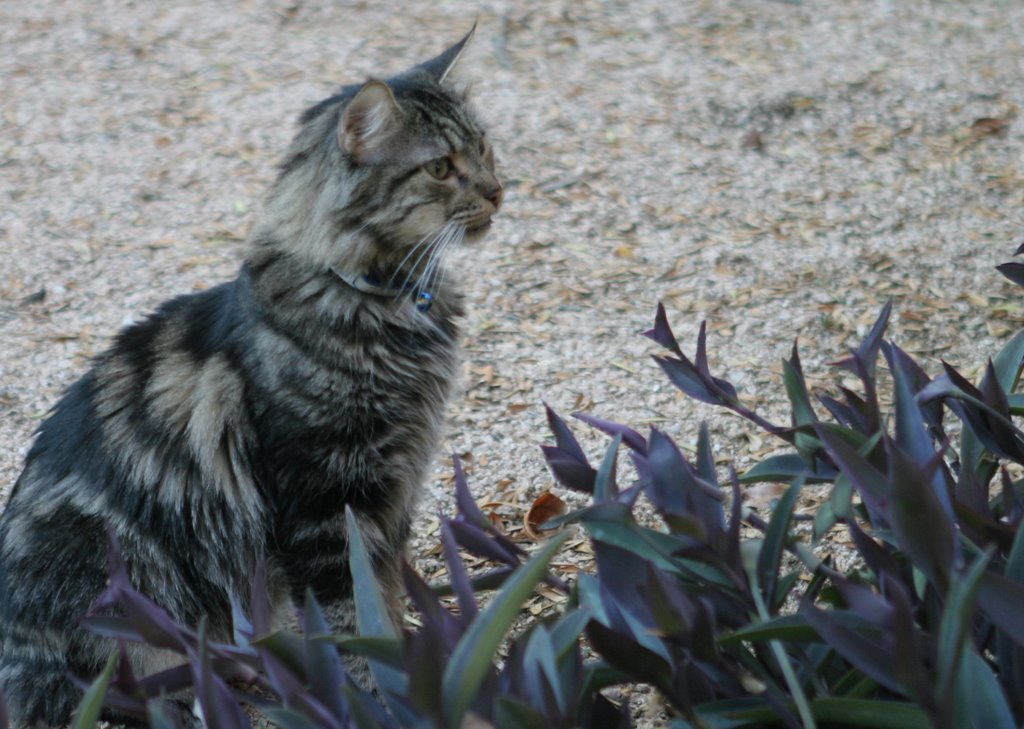
Mr. Plushy, being plushy and doing cat stuff.


In a nine-page memorandum, the two officials, Gordon R. England, the acting deputy secretary of defense, and Philip D. Zelikow, the counselor of the State Department, urged the administration to seek Congressional approval for its detention policies.
They called for a return to the minimum standards of treatment in the Geneva Conventions and for eventually closing the detention center at Guantánamo Bay, Cuba. The time had come, they said, for suspects in the 9/11 plot to be taken out of their secret prison cells and tried before military tribunals.
snip
When the paper first circulated in the upper reaches of the administration, two of those officials said, it so angered Defense Secretary Donald H. Rumsfeld that his aides gathered up copies of the document and had at least some of them shredded.
“It was not in step with the secretary of defense or the president,” said one Defense Department official who, like many others, would discuss the internal deliberations only on condition of anonymity. “It was clear that Rumsfeld was very unhappy.”
The element of the new legislation that raised the sharpest criticism among legal scholars and human rights advocates last week was the scaling back of the habeas corpus right of terrorism suspects to challenge their detention in the federal courts. But in dozens of high-level meetings on detention policy, officials said, that provision was scarcely even discussed.



"Buried in the complex Senate compromise on detainee treatment is a real shocker, reaching far beyond the legal struggles about foreign terrorist suspects in the Guantanamo Bay fortress. The compromise legislation, which is racing toward the White House, authorizes the president to seize American citizens as enemy combatants, even if they have never left the United States. And once thrown into military prison, they cannot expect a trial by their peers or any other of the normal protections of the Bill of Rights. (my emphasis added)
"This dangerous compromise not only authorizes the president to seize and hold terrorists who have fought against our troops 'during an armed conflict,' it also allows him to seize anybody who has 'purposefully and materially supported hostilities against the United States.' This grants the president enormous power over citizens and legal residents. They can be designated as enemy combatants if they have contributed money to a Middle Eastern charity, and they can be held indefinitely in a military prison."
Here’s what happens when this irresponsible Congress railroads a profoundly important bill to serve the mindless politics of a midterm election: The Bush administration uses Republicans’ fear of losing their majority to push through ghastly ideas about antiterrorism that will make American troops less safe and do lasting damage to our 217-year-old nation of laws — while actually doing nothing to protect the nation from terrorists. Democrats betray their principles to avoid last-minute attack ads. Our democracy is the big loser.
snip
But Americans of the future won’t remember the pragmatic arguments for caving in to the administration.
They’ll know that in 2006, Congress passed a tyrannical law that will be ranked with the low points in American democracy, our generation’s version of the Alien and Sedition Acts.
"How far from our historic and Constitutional values are we willing to stray? How mercilessly are we willing to treat those we suspect to be our enemies? How much raw, unchecked power are we willing to hand over to the executive?"






BAGHDAD, Iraq, Sept. 15 — The Iraqi government plans to seal off Baghdad next month by ringing it with a series of trenches and setting up dozens of traffic checkpoints to control movement in and out of the city of seven million people, an Interior Ministry spokesman said today.
The effort is one of the most ambitious security projects in recent memory, with cars expected to be funneled through 28 checkpoints along the main arteries snaking out from the capital. Smaller roads would be closed off. The trenches would run across farmland or other open areas to prevent cars from evading the checkpoints, said the ministry spokesman, Brig. Gen. Abdul Karim Khalaf.
“We’re going to build a trench around Baghdad so we can control the exits and entrances so people will be searched properly,” he said in a telephone interview. “The idea is to get the cars to go through the 28 checkpoints that we set up.”

 Posts
All Comments