This amazing aerial view of the Alps is courtesy of our good friend Barry in Alaska who is owned by pirate kitteh Zoey.






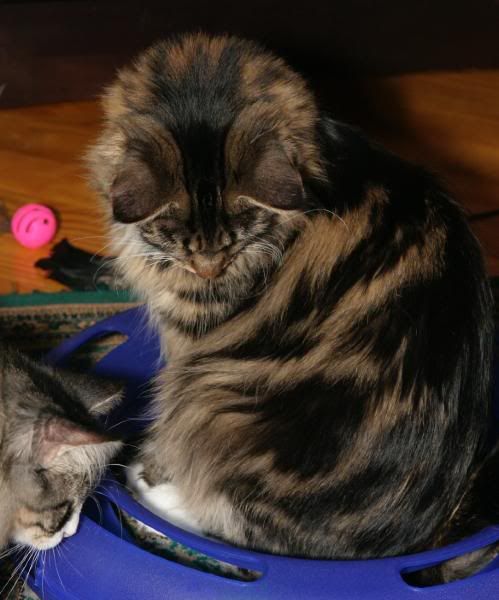
 or elz I jump on UR haid
 ... and I bite U in UR ass..
 Photo copyright Lance McVay.
Some auroras can only be seen with a camera. They are called sub-visual and are too faint to be seen with the unaided eye. The reason is that the human eye only accumulates light for a fraction of a second at a time, while a camera shutter can be left open indefinitely. When photographing an already picturesque scene above Juneau, Alaska, USA, a camera caught green sub-visual aurora near the horizon. Auroras are sparked by energetic particles from the Sun impacting the magnetic environment around the Earth. Resultant energetic particles such as electrons and protons rain down near the Earth's poles and impact the air. The impacted air molecules temporarily lose electrons, and when oxygen molecules among them reacquire these electrons, they emit green light. Auroras are known to have many shapes and colors.But nevermind all that. Aurora's always make me think of Yukon Cornelius.
 Evil carrots... I killz them.
  String theory? I gots it.
 Pink tongue? I slays U with mah cutitude.

The M51 "Whirlpool Galaxy" shines as one of the brightest spiral galaxies in the night sky.
Several NASA space observatories combined to produce this composite image. The Chandra X-ray Observatory shows purple, point-like sources that indicate black holes and neutron stars in binary star systems, and also picks up on the glow of hot gas lighting the space between the stars. The Hubble Space Telescope provides optical data in green, while the Spitzer Space Telescope sees red infrared emissions — both reflect lanes of stars, gas, and dust in the galaxy's spiral arms. The Galaxy Evolution Explorer completes the image with views of hot, young stars giving off ultraviolet energy in blue.
The spiral shape may be a result of a galactic encounter when NGC 5195 passed through M51's main disk about 500 million years ago. That gravitational tug-of-war likely triggered a new round of starbirth, as gravitational forces condensed gas and jump-started the process of star formation.

LOS ANGELES - Saturn's shimmering rings may be as old as the solar system, scientists said Wednesday, debunking earlier theories that the rings were formed during the dinosaur age.And they recycle! excellent.
Astronomers had thought Saturn's rings were cosmically young, likely born some 100 million years ago from leftovers of a meteoric collision with a moon, based on data by NASA's Voyager spacecraft in the 1970s.
However, new data from the orbiting international Cassini spacecraft suggest the rings existed as far back as 4.5 billion years ago, roughly the same time the sun and planets formed. The probe also found evidence that ring particles are constantly shattering and regrouping to form new rings.
"Recycling allows the rings to be as old as the solar system although continually changing," said Larry Esposito, a Cassini scientist from the University of Colorado.


This handout photo released in Seoul by the Ministry of Science and Technology shows a combo of cloned cats that have a fluorescence protein gene and glowing under ultraviolet beams. The technology could help develop treatments for human genetic diseases, the developers said.Hat tip to Darryl Pearce.


 Yes, I noes, iz blurry, noe flashy!
 She seems to always cross her paws these days.
  Oooof. Fluffy tummy and bugs bunny feetsies on display.

 Posts
All Comments
Posts
All Comments